
Collection: Plant Stands & Hangers
A plant on the floor is a plant the light never reaches. Stands and hangers lift it into the window, in bamboo, metal and rope. Check the pot diameter a stand takes before you choose a style, because most of them take exactly one size.

-
Bamboo Plant Stand with Four Leg Base
Regular price From $24.95 USDRegular price -
Vegan Leather and Rope Hanging Plant Holder, Two Sizes
Regular price From $23.97 USDRegular price -
Macrame Plant Hangers, Set of 4
Regular price $47.97 USDRegular price -
Solid Wood Plant Pot Riser Stand, Three Sizes
Regular price From $33.97 USDRegular price -
Wall-Mounted Air Plant Holders, Set of 2
Regular price $30.95 USDRegular price

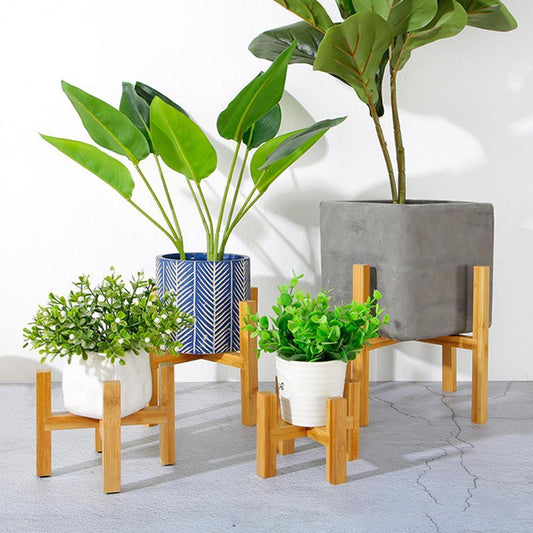

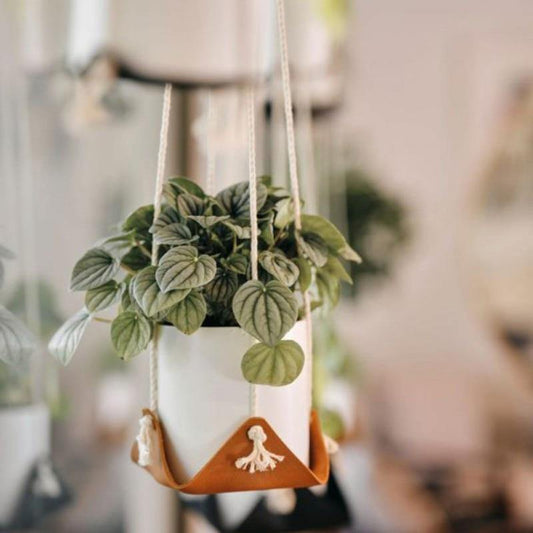


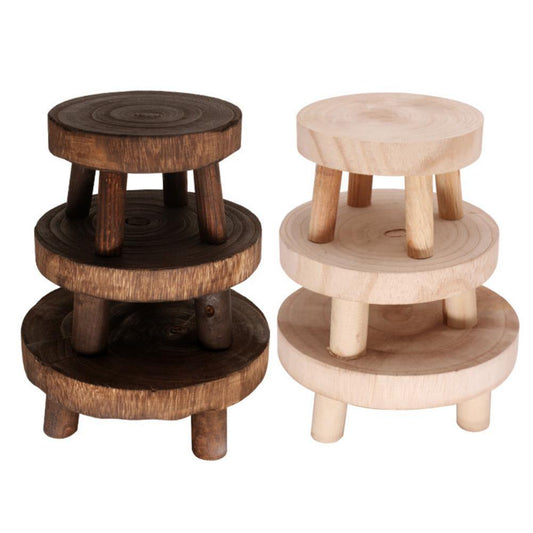


You are buying light, not furniture
Light falls off fast as you move away from a window. At the glass a plant gets the full amount, three feet (90 cm) back it gets near half, and eight feet (240 cm) back a fraction of that. It is why the plant in the middle of the room drops its lower leaves and the one on the sill does not.
A stand or a hanger fixes that in a way no fertilizer can. Lifting a pot 24 in (61 cm) off the floor and setting it 2 ft (60 cm) closer to the glass often doubles what the leaves receive. That is the whole purpose of this category, and it is worth choosing on that basis before style enters the conversation.
Floor space is the second reason. A 12 in (30 cm) pot on the floor blocks a square foot you have to walk around. At hip height in a corner it stops being in the way.

Measure the pot, not the plant
Nearly every returned plant stand is the wrong size, and it is nearly always the same mistake: measuring the plant instead of the pot. Measure the outside diameter of the pot at its widest point, which is usually the rim, and measure the height too if the stand has a ring rather than a flat top.
Most stands take exactly one size. A fixed bamboo cross frame sized for an 8 in (20 cm) pot will not hold a 10 in one at all, and a 6 in pot sits in it lopsided. Adjustable frames slide across a range, usually something like 8 to 12 in (20 to 30 cm), and they are worth the small extra cost because the plant will be repotted one size up within two years.
Ring stands are different again. The pot hangs through the ring by its rim, so the number that matters is the pot diameter just under the lip, not at the widest point. A tapered pot drops straight through a ring cut for a straight sided one.

| Pot diameter | Stand opening to look for | Weight when watered | Check |
|---|---|---|---|
| 4 in (10 cm) | 4 to 5 in (10 to 13 cm) | 1 to 2 lb (0.5 to 0.9 kg) | Light pots tip easily, so favor a wide base |
| 6 in (15 cm) | 6 to 7 in (15 to 18 cm) | 3 to 5 lb (1.4 to 2.3 kg) | The most common houseplant size, easiest to fit |
| 8 in (20 cm) | 8 to 9 in (20 to 23 cm) | 8 to 12 lb (3.6 to 5.4 kg) | Ceramic adds 3 lb (1.4 kg) over plastic on its own |
| 10 in (25 cm) | 10 to 11 in (25 to 28 cm) | 15 to 25 lb (7 to 11 kg) | Past the rating of most bamboo frames |
| 12 in (30 cm) | 12 to 13 in (30 to 33 cm) | 30 to 40 lb (14 to 18 kg) | Steel or hardwood only, and check the stated load |
| 14 in (36 cm) and up | Adjustable or a plant caddy on castors | 50 lb (23 kg) and up | You will want wheels, not a stand |
How tall it should be
Height follows what sits beside it. Next to a sofa or an armchair, a stand of 12 to 18 in (30 to 46 cm) puts the pot rim near arm height, so the foliage reads across the seat instead of behind it. In an empty corner, 24 to 32 in (61 to 81 cm) works, because there is nothing else there to give the plant a scale.
Then check the total. Stand height plus pot height plus plant height is the number that has to fit under a window head, a shelf or a sloped ceiling, and it is the number nobody adds up before ordering. A 30 in (76 cm) stand under a windowsill at 32 in puts the plant against the glass rather than in front of it, which is worse for it in a cold snap.
Tall plants want short stands and short plants want tall ones. A 4 ft (122 cm) fiddle leaf fig on a 30 in stand becomes a ceiling problem. Put it on a 6 in (15 cm) riser instead, which lifts the pot off a cold floor and keeps the proportions honest.
Three legs, four legs, and floors that are not flat
Three legs always sit flat, on any floor, because three points define a plane. Four legs rock on an uneven board and rock harder once a heavy pot is on top, and old floors are rarely level. If the floor is boards rather than tile, three legs is the safer buy.
Stability comes from the base width against the height. A stand whose base is narrower than its top is a stand waiting for a knee or a cat, and top heavy plants make it worse: a snake plant is nearly all weight above the rim. As a rough test, the base should be at least half the total height for anything above 24 in (61 cm).
Check the stated load and treat it as an honest ceiling rather than a target. Bamboo frames are typically rated around 20 to 30 lb (9 to 14 kg), powder coated steel two or three times that. A 10 in (25 cm) pot watered can pass 20 lb (9 kg) on its own.
Macrame hangers, and where they can actually go
A cotton hanger is a strong thing tied to a weak thing. The cord itself holds far more than the plant, and 4 mm braided cotton will carry 30 lb (14 kg) without complaint. The fixing above it is the part that fails, and a single hook in drywall pulls out under 10 lb (4.5 kg) of swinging pot.
So a hanger goes into a ceiling joist with a screw hook threaded 1 1/2 in (38 mm) into timber, or into a wall stud, or on a swag hook with a toggle if there is no joist within reach. Joists sit 16 in (41 cm) apart center to center in most US framing. Nothing about the hanger changes that requirement, however light the plant looks.
Two habits keep a rope hanger honest. Check the knots after the first week, since new cotton cord stretches and beds in under load, and the arms often need evening up once. And keep the pot inside the cradle rather than resting on the knot below it, because a pot that sits on the bottom knot is being held by one strand instead of four.
Bamboo, steel and cotton
The material decides where a stand can live and how long it lasts there. Damp is the deciding factor indoors as much as out, since a bathroom or a plant that gets watered in place is a wet environment for whatever is under it.
| Bamboo and wood | Powder coated steel | Cotton macrame | |
|---|---|---|---|
| Typical load | 20 to 30 lb (9 to 14 kg) | 50 lb (23 kg) and up | Limited by the hook, not the cord |
| In a damp room | Swells and stains without a sealed finish | Fine until the coating chips | Slow to dry, and it can mildew |
| On uneven floors | Good, if it has three legs | Thin feet dent soft wood | Not applicable, it hangs |
| Ages by | Graying in sun, splitting at joints | Rust blooming from chips and cut ends | Yellowing in direct sun over two years |
| Floor space used | A full footprint | A full footprint | None at all |
What happens to the floor underneath
A plant stand does not protect a floor. It raises the pot, and the water still lands below. A saucer that overflows once a week leaves a dark ring on hardwood within a couple of months, and by the time the stain shows it has gone through the finish into the wood.
The reliable arrangement is three layers: a drainage hole in the pot, a saucer that holds at least 20 percent of the water you pour, and a barrier under the whole stand. Cork or felt pads under the feet handle condensation and scratching. A waterproof mat is better under anything over 10 in (25 cm), because those get watered with a can rather than carried to the sink.
Terracotta deserves a warning of its own. Unglazed clay wicks moisture straight through its wall and passes it to whatever it touches, so a terracotta pot standing directly on a wooden shelf will mark it even if you never spill anything. Two pot feet or a glazed saucer break that contact.
The one object here that holds nothing
Everything else in this shop is defined by what goes inside it. A stand is the exception: it holds nothing itself and exists so that something else can be held higher. That is worth remembering while shopping, because it means the stand should not be the interesting object in the corner.
The practical version of that is to buy the plant and the pot first, then the stand that fits both, then check the light where it will go. Doing it the other way around is how people end up with a stand that suits the room and takes a pot size they do not own.
One more habit worth keeping. Turn the pot a quarter turn every time you water. A plant on a stand in a window leans toward the glass faster than one in the middle of a room, because the difference in light between its two sides is much larger up there.
Common questions
How do you pick a plant stand?
Start with the outside diameter of the pot at its widest point, since most stands take one size and nothing else. Then check the stated load against the watered weight of the pot, which for a 10 in (25 cm) pot is around 20 lb (9 kg). Choose the height from what sits next to it, roughly 12 to 18 in (30 to 46 cm) beside a sofa and 24 to 32 in (61 to 81 cm) in an empty corner. Three legs last on uneven floors, four legs rock.
What plants look best on stands?
Plants with an upright habit and a defined shape: snake plants, ZZ plants, rubber plants, dracaena and small palms all read well raised up. Trailing plants work on a stand only if the trail is short, since a long one ends up on the floor and gets stepped on. Anything with a heavy top and a small pot, a snake plant being the obvious case, needs a wide based stand or it goes over.
How tall should a plant stand be?
For a plant beside seating, 12 to 18 in (30 to 46 cm) puts the pot near arm height where the foliage is visible across the seat. For an empty corner, 24 to 32 in (61 to 81 cm) gives the plant scale against the wall. Always add stand height plus pot height plus plant height and check that total against the window head or shelf above. Tall plants want short stands, not tall ones.
What size plant stand do I need for a 10 inch pot?
One with an opening of 10 to 11 in (25 to 28 cm) and a stated load of at least 25 lb (11 kg), because a 10 in pot with wet soil comes in near 20 lb (9 kg) and ceramic adds more. Many bamboo frames stop below that, so read the load figure rather than assuming. An adjustable frame covering 8 to 12 in (20 to 30 cm) is the safer buy, since it still fits after the next repot.
How do you hang a plant hanger on a wall?
Into a stud, using a lag hook or a #8 screw driven at least 1 1/2 in (38 mm) into the timber. Studs sit 16 in (41 cm) apart center to center in most US framing, and a stud finder or an outlet box will locate one. If nothing lands where you need it, a toggle bolt gives you around 20 lb (9 kg) in drywall, and that is the ceiling for the pot, the soil and the water together. Adhesive hooks do not hold a plant.
How many cords do I need for a macrame plant hanger?
Four cords folded in half gives eight working strands, which is the standard for a hanger holding a 6 to 8 in (15 to 20 cm) pot. Cut each cord about four times the finished length you want, so roughly 12 ft (3.7 m) of cord per strand for a 36 in (91 cm) hanger. Cotton cord of 4 mm is the usual weight. Running short mid project is the common failure, so cut long.
What do you put under plants to protect the floor?
A saucer deep enough to hold about a fifth of the water you pour, plus cork or felt pads under the stand feet, plus a waterproof mat for anything over 10 in (25 cm). Unglazed terracotta needs pot feet or a glazed saucer of its own, since clay wicks water through its wall and marks wood without any spill happening. Once a dark ring appears on hardwood, the water is already through the finish.
