
Collection: Christmas
Christmas pieces that do not look like Christmas from October onward. Table linen, ornaments and gift bags in finishes that sit with the rest of the room rather than replacing it for a month.

-
Memorial Angel Christmas Ornament, Packs of 2, 4 or 8
Regular price From $24.95 USDRegular price -
Christmas Tablecloth with Snowmen and Reindeer, Polyester
Regular price From $39.00 USDRegular price -
Christmas Drawstring Gift Bags, 18 or 50 Pack
Regular price From $34.95 USDRegular price



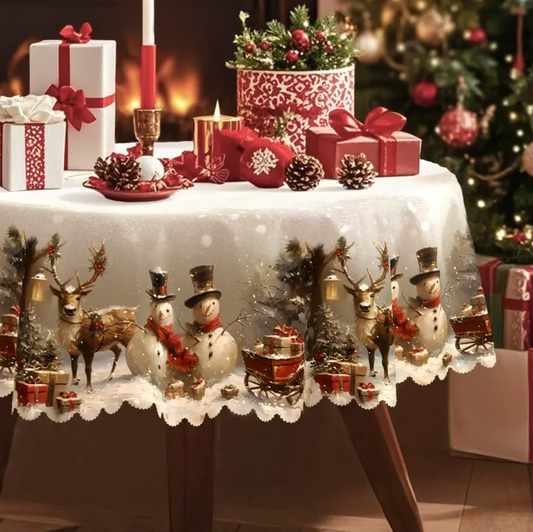

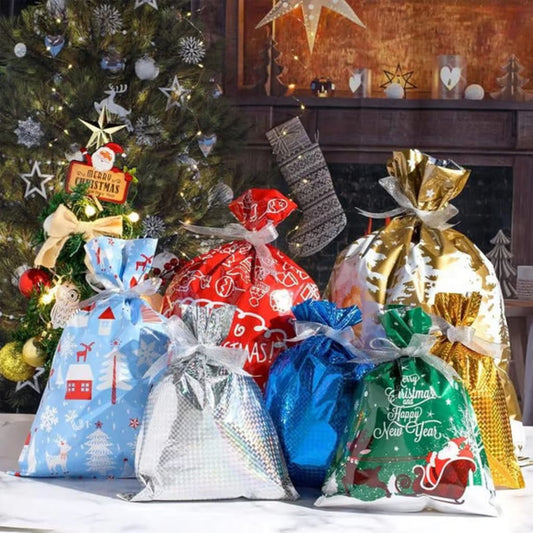

The table gets used more than the tree
A tree is looked at. A table is sat at, eaten off, spilled on and cleared four times in a week. In most homes the table is where the whole of December actually happens, and it is the surface people spend the least time thinking about until the day before.
That matters for a practical reason. Tree decoration is forgiving, because a branch hides a mistake. A table is not, because everything on it sits at eye level for two hours while people talk across it. A cloth that is 6 in too short reads as wrong from the first course, and no amount of centerpiece fixes it.
So the order worth working in is table first, tree second, everything else after. Get the cloth size right, decide what holds the food, and the rest of the room can stay as it is for the rest of the year.
Tablecloth size: the drop is the whole decision
A tablecloth is described by the size of the flat rectangle or circle, not by the table it fits. To get from one to the other, decide how far you want the fabric to hang over the edge, and add twice that to each dimension of the table. That hanging length is the drop, and it is the only number that changes the look.
A drop of 8 to 10 in (20 to 25 cm) is everyday: the cloth clears the edge, and nobody catches it standing up. Around 15 in (38 cm) is the dinner setting, low enough to sit in laps but well short of the floor. Full floor length on a standard 30 in (76 cm) high table means a 30 in drop, which hides the legs completely and turns the table into a solid block. That last one is worth doing when the table underneath is a folding one.
Stocked sizes do not land exactly on the math, so round up rather than down. An inch of extra drop reads as nothing, and an inch short reads as a mistake.

| Your table | Casual, 10 in drop | Dinner, 15 in drop | Floor length |
|---|---|---|---|
| 6 ft folding, 72 x 30 in | 50 x 92 in | 60 x 102 in | 90 x 132 in |
| 6 ft dining, 72 x 40 in | 60 x 92 in | 70 x 102 in | 100 x 132 in |
| 8 ft dining, 96 x 40 in | 60 x 116 in | 70 x 126 in | 100 x 156 in |
| 4 ft round, 48 in across | 68 in round | 78 in round | 108 in round |
| 5 ft round, 60 in across | 80 in round | 90 in round | 120 in round |
| Square, 36 in across | 56 in square | 66 in square | 96 in square |
How many ornaments a tree actually takes
The count that looks right is higher than most people guess, which is why a tree bought fresh with one box of ornaments looks thin. The working rule is 10 ornaments per foot of tree height for a spare look and 20 per foot for a full one, plus around 100 lights per foot of height.
Those numbers assume the ornaments are mixed sizes. A hundred balls all 3 in across reads as wallpaper. The usual mix is roughly a third large pieces at 4 in and up placed deep near the trunk, a third mid sized at around 3 in on the middle of the branches, and a third small at 2 in filling the outer tips. Depth is what stops a tree looking like a cone with decorations stuck to the front.
| Tree height | Lights | Ornaments, spare | Ornaments, full |
|---|---|---|---|
| 3 ft | 100 | 30 | 60 |
| 4 ft | 200 | 40 | 80 |
| 6 ft | 500 to 600 | 60 | 120 |
| 7.5 ft | 750 | 75 | 150 |
| 9 ft | 900 to 1000 | 90 | 180 |
Glass or shatterproof, and what shatterproof really means
Glass ornaments hold color with depth because the light goes into the glass and comes back out. Painted plastic reflects off the surface instead, which is why a plastic ball photographs almost the same and looks flatter in a lit room. Glass also has weight, so it hangs straight and steady rather than swinging on a draft.
Shatterproof means resistant, not unbreakable. The material is usually a molded plastic that survives a fall onto carpet and dents or splits on tile at the wrong angle. What it genuinely solves is the aftermath: a dropped glass ball scatters fine shards under furniture, and that is the real argument for plastic in a house with a crawling baby, a dog with a tail, or a cat with opinions about tinsel.
The compromise most people land on is glass at the top and in the middle of the tree, plastic on the bottom two feet where hands and paws reach. It costs nothing to arrange and it removes the entire problem.
- Glass: deeper color, hangs straight, sounds right, breaks into small pieces that get everywhere
- Plastic: light enough for thin outer branches, survives carpet drops, glitter sheds over a few seasons
- Wood and resin: no shine, but they do not fade and they store badly stacked without harm
- Anything mirrored: shows fingerprints from every hand that hung it, so handle by the cap
Working outside red and green
Red and green are the default because they are the only two colors that announce the season on their own. The cost is that they announce it loudly, and a room decorated in them stops being your room for five weeks.
The alternative is not to avoid color but to borrow from what the room already has. Pick the two colors that are already in the space, add one metal, and stop there. Cream and bone with brass reads warm and does not fight a wood floor. Deep green with cream sits quietly against a white wall. Black with gold works in a room that already has dark furniture, which is most rooms with a bookcase in them.
The tell that it worked is simple. On January 3, when the tree has gone, anything left on the table or the shelf should still look deliberate rather than forgotten. Table linen in a plain weave, plain glass, brass candlesticks and a bowl of fruit all pass that test. A printed snowman cloth does not, and it is not supposed to, which is why it goes back in the bin for a year.
Linen: fold lines, wine and candle wax
A cloth that has been folded in a bag for eleven months arrives with hard creases along the folds, and those creases are set by pressure and time rather than heat. Steam is what releases them. Iron on the reverse while the fabric is still slightly damp, or hang the cloth in a bathroom while somebody showers and let it settle for an hour. Never press directly on a metallic or foil print, because the print lifts onto the soleplate.
Red wine has one rule that beats every remedy argument: blot, do not rub, and keep it wet. Rubbing pushes pigment into the weave. Cover the wet stain in salt to pull the liquid up, rinse from the back of the fabric with cold water so the wine travels out rather than through, then treat with a dish soap and hydrogen peroxide mix on white cotton before washing. Hot water sets it permanently, and a tumble dryer sets it beyond recovery, so keep the cloth out of the dryer until the stain has actually gone.
Candle wax is easier than it looks. Let it harden completely, or speed it up with a bag of ice, then crack it off with a blunt edge. Whatever stays in the weave comes out between two sheets of plain brown paper under a warm iron, which melts the wax into the paper. Move to a clean part of the paper each pass, or you press the wax straight back in.
Packing it away so it survives the year
Ornaments break in storage far more often than they break on the tree. What breaks them is other ornaments, so the fix is separation: a box with dividers, or a carton with a cardboard grid dropped in, or an egg carton for the small balls. Wrap glass in plain tissue rather than newspaper, since newsprint transfers onto pale finishes over a year of pressure.
Table linen wants the opposite of ornaments. Roll it around a cardboard tube instead of folding it, because a fold repeated in the same place for several years eventually wears the fibers along the line and no amount of ironing brings it back. Make sure it is completely dry first. A cloth put away with any damp in it comes out with brown spots that are mildew and do not wash out.
Where it goes matters as much as how it is packed. An unheated garage or an attic swings from below freezing to over 100 F across the year, and that cycle makes plastic brittle, lifts glitter and dulls painted finishes. Somewhere inside the heated part of the house is worth the space it costs, even if that means the bottom of a closet. Take the batteries out of anything with LEDs before it goes away, and label the box by what is inside it.
Buy what holds something, and what stores flat
This is a small collection and it is meant to be. What survives eleven months in a box and still earns the space is a short list: linen that covers a table, ornaments that hang, and bags that carry gifts and then get reused. None of it is furniture and none of it needs to be.
The useful filter is the same one that applies to the rest of the house. Ask what the object holds. A tablecloth holds a table and folds to nothing. A gift bag holds a shape that paper cannot wrap, and a good one comes back next year with a different name tag. A bowl holds satsumas in December and everything else the rest of the time, which is why bowls never go in the box at all.
Anything that holds nothing and stores badly is the part of Christmas you are storing rather than using. One evening spent deciding that is the difference between two bins in the closet and six in the attic.
Common questions
How many ornaments should a 7ft tree have?
Between 70 and 140, depending on how full you want it. The working rule is 10 ornaments per foot of height for a spare tree and 20 per foot for a dense one. Mix the sizes rather than buying one box of identical balls, and hang the largest pieces deep near the trunk so the tree has depth instead of a decorated surface.
Is 50 ornaments enough for a 6 ft tree?
It is enough for a deliberately spare tree and it will look thin if you were expecting a full one. A 6 ft tree takes about 60 ornaments at the sparse end and around 120 for a dense look. If 50 is what you have, use them all on the front and sides that people see and skip the wall side, which is what most people do anyway.
What size tablecloth do I need for a 6 foot table?
Take the table dimensions and add twice the drop you want to each one. A 6 ft folding table is 72 by 30 in, so a 60 by 102 in cloth gives a 15 in drop all around, which suits a dinner. A 90 by 132 in cloth reaches the floor and hides the legs. For a 72 by 40 in dining table, the same 15 in drop needs 70 by 102 in.
Are shatterproof ornaments actually shatterproof?
They are break resistant rather than indestructible. Molded plastic ornaments survive a fall onto carpet or wood without damage and can still dent, scratch or split if they hit tile at a bad angle. What they reliably prevent is the mess: no fine shards under the sofa, which is the real reason to use them in a house with small children or pets.
Can shatterproof ornaments go outside?
Only if the listing says outdoor rated. Plastic survives being dropped but not being left out, and UV over a few weeks fades painted finishes and makes thin plastic brittle. Rain also gets into the cap and stays there. If you want something outdoors, look for a piece described for exterior use with a sealed hanger, and expect to replace it more often than an indoor one.
What is the best way to store Christmas ornaments?
Separate them so they cannot touch. A divided ornament box works, and a plain carton with a cardboard grid dropped in works just as well. Wrap glass pieces in plain tissue rather than newspaper, since newsprint transfers onto pale finishes under a year of pressure. Store the box somewhere with a stable temperature, and label it by contents so you are not opening three boxes to find the lights.
Can I store Christmas decorations in an unheated garage?
You can, but expect them to degrade faster. An unheated garage swings from below freezing to well over 100 F across a year, and that cycle makes plastic brittle, lifts glitter off glass and dulls painted finishes. Damp is the bigger problem for linen, which grows brown mildew spots that do not wash out. Textiles in particular belong inside the heated part of the house.
