
Collection: Desk & Office
A desk collects objects whether you choose them or not. Holders, stands and small pieces that keep pens, phones and controllers off the surface you are trying to work on.

-
Mechanical Hand Game Controller Stand for Desks
Regular price $39.00 USDRegular price -
Bulldog Resin Phone Holder for a Desk
Regular price $33.00 USDRegular price -
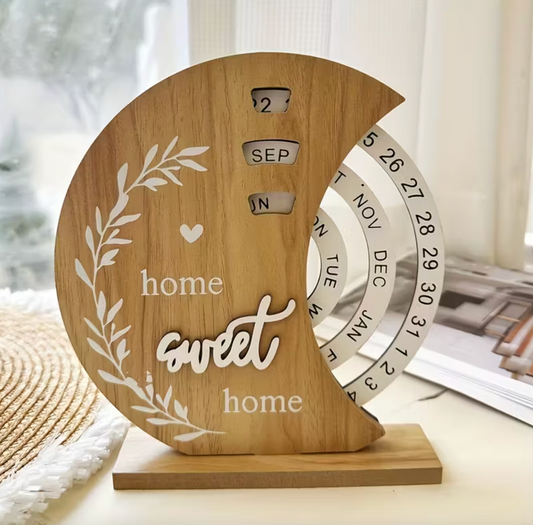
Wooden Perpetual Desk Calendar, Crescent Shape
Regular price $39.00 USDRegular price






A desk runs out of homes before it runs out of space
A cluttered desk is rarely a small desk. It is a desk where four or five objects have no fixed place, so they live wherever they were last put down, which is always the middle. Pens, the phone, a controller, headphones, the notebook: five things, five homes needed, and the surface clears the moment each one has one.
Test it before buying anything. Take everything off the desk, work for two days, and put back only what you actually reached for. Whatever came back is what needs a home. Whatever stayed off belongs in a drawer or another room, and buying a tray for it is just clutter in a nicer container.
Then protect the working strip. Keep the front 10 to 12 in (25 to 30 cm), the band directly in front of the keyboard, permanently empty. That is where paper, a plate or a laptop lands, and an object that creeps into it costs you the use of the desk rather than a bit of its area.
The reach map
Your forearm sweeps an arc of about 14 in (36 cm) from the elbow, and your whole arm reaches about 24 in (60 cm). Those two arcs sort a desk, and most organizing problems are objects sitting in the wrong one.
| Distance from the front edge | What belongs there | What does not |
|---|---|---|
| 0 to 12 in (0 to 30 cm) | Nothing permanent, this is the working strip | Trays, cups, stands, plants |
| 12 to 20 in (30 to 50 cm) | Keyboard, mouse, the pen holder, the phone stand | Anything you touch less than once an hour |
| 20 to 28 in (50 to 71 cm) | Screen, lamp, notebook, a controller cradle | Storage you have to dig through |
| Beyond 28 in (71 cm) | A calendar, a clock, a figure, a plant | Anything needed while you are working |
Holders are built around one object
Nearly everything on this page is a hollow shaped to fit one thing, and the shape decides whether it works at all. A cradle sized for a game controller will not hold a phone. A cup meant for pencils swallows a pair of scissors point down and hands you the blade. Measure the object you own before the holder arrives.

| Holder | What it takes | Check before buying |
|---|---|---|
| Pen cup or figure holder | Ten to twelve pens at about 3 in (7.5 cm) across | Wider than that and you dig through it every time |
| Flat pen tray | Three or four pens you use daily | Needs a lip taller than the pen barrel, or the pen rolls out |
| Phone stand | One phone, at a glancing angle near 60 degrees | Whether the cradle clears your case and the charging port |
| Controller or headset cradle | One controller, or one headband | The width of the grip, and whether the base outweighs it |
| Desk calendar | A date, and nothing else | That it covers 31 day months, and that you can read it at a glance |
Why pens roll, and what stops them
A round barrel needs almost no slope to start moving, and no desk stays truly level once it has been carried up a staircase. The pen that falls behind the desk twice a week is geometry rather than carelessness.
Three fixes, in order of how well they hold. A vertical holder ends the problem completely, since a pen standing on its end cannot roll, which is why the cup outlived every desk tidy ever designed. A tray works only if its lip is taller than the pen is thick. A desk pad is the quiet third option: the 2 mm step at its edge stops a pen dead and marks out the working strip at the same time.
Put whichever you choose on the side of your writing hand, 12 to 20 in (30 to 50 cm) back from the front edge, so putting a pen away is one movement instead of a reach across the keyboard. And if you want the holder to be a figure rather than a plain cup, check the opening: a novelty holder often has a smaller cavity than its outside suggests, and six pens can be its real limit.
The analog object on a screen desk
The computer already knows the date, so a wooden calendar on a desk is not there to inform you. It is there because you set it with your hands on a Monday morning, and because a small object you touch once a day earns its footprint in a way a printed sheet does not.
Two things separate one that gets used from one that gets stuck in March. It has to handle every month length, which means enough number blocks or a dial that reaches 31, and it has to be readable from where you sit rather than from directly above. A calendar you have to lean over is a calendar you stop turning by the second week.
Wood on a desk asks for very little: a dry cloth, and no windowsill. Direct sun over months bleaches oak and beech unevenly, and the side facing the window ends up a shade lighter than the rest. Keep it back from the glass, out of the working strip, and it will outlast most of what shares the desk with it.
Resin, wood and metal, one year in
Most desk pieces are cast resin, and cast resin is heavy in a way that helps: the mass is what keeps a stand still when you pull a phone off it one handed. It chips rather than dents, and it chips at the thin points, so look at the photo for the narrow parts, the fingers, the ears, the tip of a nose. Those are the parts that hit the floor first.
Wood moves and metal marks. A wooden piece in a room with dry winter heating shrinks slightly and can open a glue joint at a seam; a metal base will leave a gray line on a pale desk if it slides even once. Both are fixed with the same forty cents of felt: stick pads on the underside of anything with a hard base, and it stops both the sliding and the mark.
Check the base of anything you buy to hold something else. Pick the piece up, take the phone or the controller out of it with one hand, and see whether it stays put. A weighted base does. A hollow plastic one walks forward across the desk, then tips, and it does that from the first day rather than after a year.

Decoration that earns its footprint
A desk is the one surface where decoration pays rent. Every object costs working area, so the pieces that survive a year are the ones doing a job as well as being looked at: a figure that holds pens, a hand that holds a controller, a stand that keeps the phone upright, a calendar you turn.
Scale is what people misjudge. Desk objects are seen from about 20 in (50 cm) away and from above, so a piece that reads as small in a product photo can take over the corner it lands in. As a rough line, anything with a footprint over about 5 in (13 cm) across should be doing something functional, or it belongs on a shelf where it is seen from further back.
Two or three pieces is usually the ceiling. Past that they stop reading as chosen objects and start reading as things that have accumulated, which is the exact impression a desk gives when nothing on it has a home.
Buying for somebody else's desk
A desk is personal in a way a kitchen is not, and gifts for one fail in a predictable way: they arrive as an extra object on a surface that had no room to start with. What gets kept is whatever replaces something already doing the job badly, or gives a homeless object a home at last.
So the reliable picks are dull on paper and used daily. A stand for the phone that currently lies face down beside the keyboard. A holder for the pens living in a mug with a broken handle. A cradle for the controller that sits on the desk between sessions. A calendar for someone who works from home and loses track of the date, which happens more than people admit.
Skip anything that has to fit hardware you have not measured, and skip storage for a desk you have never seen. If the point is the object rather than the function, keep it under about 4 in (10 cm) across, because that is the size that finds a corner instead of demanding one.
Common questions
How do you organize a desk without drawers?
Give every object that lives on the desk a container, and keep the front 10 to 12 inches clear as a working strip. A pen holder, a stand for the phone, a cradle for anything bulky like a controller, and a hook under the desk for headphones covers most setups. Move the rest off the surface entirely, onto a shelf above or a cart beside the desk. What stays on top should be things you touch at least once an hour.
How to store pens on a desk?
Vertically. A pen standing on its end cannot roll, which is the whole reason cups have outlasted every other desk tidy. About 3 inches (7.5 cm) across holds a dozen pens without becoming something you dig through. A shallow tray works for the three or four you use constantly, provided its lip is taller than the pen barrel. Keep it on the side of your writing hand, 12 to 20 inches back from the front edge.
What is the best pen holder for a desk?
The one whose opening matches how many pens you actually keep. A single wide cup is best if you own a dozen, and a narrow or figure shaped holder suits four or five, since a novelty holder usually has a smaller cavity than its outside suggests. Weight matters as much as shape: a light plastic cup tips when you pull a pen out at an angle, while a resin, stone or metal base stays put. A compartment or two helps if scissors and a ruler live there too.
How to stop things falling off the back of the desk?
Push the desk to the wall if you can, since a two inch gap swallows pens, cables and paper indefinitely. If the desk has to stand off the wall, close the gap with a strip of foam or a length of pipe insulation pressed into it, or run a cable tray along the back edge, which blocks the gap and holds the cables at the same time. On a desk in the middle of a room, keep everything rollable in a vertical holder rather than lying flat.
How high should a monitor be on a desk?
Top edge at eye level or slightly below, with the screen about an arm's length away, 20 to 30 inches (50 to 76 cm) from your face, tilted back 10 to 20 degrees. On a 27 inch monitor, drop it a little further so the top sits just under eye level, because the middle of a large screen is the part you read. Given a choice between slightly too low and slightly too high, choose too low.
Is 29 inches too high for a desk?
It is the standard height, and it is too high for plenty of people, which is an odd thing about desks. The 29 to 30 inch figure suits someone around 6 feet tall with the chair set correctly. If your elbows sit above the desktop with your shoulders relaxed, the desk is too high for you: raise the chair until your forearms are level with it, then add a footrest so your feet are supported.
What is a good gift for someone who works from home?
Something that replaces an object already doing the job badly. A phone stand for the phone lying face down next to the keyboard, a proper holder for pens living in a chipped mug, a desk calendar, or a small lamp if the room runs on one overhead light. Avoid anything that has to fit hardware you have not measured, and keep purely decorative pieces under about 4 inches across, since desk space is what they are shortest of.
